By Chris Kelly (@ccalciok)
Over the years, across the entire history of football, an immeasurable amount of players and people have made a huge impact on the game and the dynamics that surround it.
Be it through their quality and style of play, their cultural standing and background or the modern day marketing potential of football in the current climate – many have left a lasting imprint on the sport, both shaping football’s direction and defining the time of their involvement.
Everybody will have their own thoughts on this, their own choices. So many have moulded, changed and revolutionised football for varying reasons – some resonating with people for their own, individualistic cause – that it’s impossible to look at each and every one in a detailed manner.
During this four-part series, I’m going to take a look at eight players who have left a legacy in the game to one degree or another. Some who best encapsulate the era and time in which they played, some who almost defined their generation through their style and persona, players who changed the footballing landscape by varying means along with those whose sheer footballing brilliance marks them out as some of football’s all time greats.
There’s no right or wrong choice when looking at this. It’s a very individual decision trying to narrow down on who has affected the game, for a variety of ways. Therefore the likes of Dixie Dean, Sir Tom Finney, Ferenc Puskás, Alfredo Di Stéfano, Sir Bobby Charlton, Just Fontaine, Bobby Moore, Garrincha, Zico, Laurie Cunningham, Sócrates, Pelé, Franco Baresi, Paolo Maldini, Eric Cantona, Zinedine Zidane and Ronaldo Nazário – amongst many, many others – could all have legitimate claims and valid reasons for their inclusion.
However, in the interest of balance, I’ve spread the eight players chosen across a wide scale chronologically, to get an overall view of how football and footballers have evolved along with how the needs of the game have changed with them.
Walter Tull
Walter Daniel John Tull was born in Folkstone, 1888 – and was a pioneer in both professional football and the British Army. Tull, who played for Clapton FC, Tottenham Hotspur and Northampton Town, was of Afro-Carribbean heritage and one of the very first people of colour to play top level football in England at a time when, perhaps, racial prejudices and segregation was far more intense than that of today.

Alongside his footballing career, Walter Tull also became the first person of mixed heritage to command a battalion of troops as the First World War broke out in 1914. Tull, then of Northampton Town, enlisted in the Army, rising from a member of the Duke of Cambridge’s regiment to second lieutenant and serving his country in a gallant and praiseworthy manner until he was sadly killed in battle in northern France in the spring of 1918, aged just 29.
Tull had a difficult start to life, with both his parents passing on by the time he was nine years old. From that point he grew up in a London orphanage with his brother Edward. Upon joining successful local amateur club Clapton FC in 1908, Tull impressed greatly, winning many cup competitions with the club before signing for top flight side Tottenham Hotspur a year later.
As mentioned previously, this made the inside forward (who could also operate defensively) only the third player of mixed heritage to play at the highest level of English football, as well as becoming the very first of which to participate in football across Latin America during Tottenham’s pre-season tour of Uruguay and Argentina.
Tull started well at Spurs, but only played ten games before being strangely dropped to the reserves, with speculation that racial abuse suffered at various stadiums was the reason for him being left out.

Though a few more appearances for the club have been recorded, Tull struggled to get back into the starting lineup and joined Northampton Town, then of the Southern League, in 1911. Settling nicely at his new home, he went on to play 111 times for ‘The Cobblers’ over a three year period, before the First World War commenced and Tull joined the forces.
It has since been confirmed that, in 1917 and in the midst of battle, Tull had agreed to join Scottish giants Rangers FC at the end of the war; something he was destined to be unable to fulfill due to his falling in conflict.
It’s fair to say Walter Tull’s life and career are both unique yet symbolic of that era in time. Life in general was tough, requiring strong characters – and people were, perhaps, a little regimented in their views while performing honourably when duty bound and accepting of some of the limitations bestowed on them for various reasons.
However, though Tull’s life began in a rather grim and meagre fashion, he pushed himself – followed his dreams (and morals) and became something of a rarity in both footballing and military terms, down to his racial background. He was an inspirational figure in his desire and dedication to carry out such roles against the backdrop of considerable discrimination and barriers that existed in a much harsher manner than they do today.
He was also symbolic of footballers at that time, where the game didn’t perhaps take on the importance of nowadays, wages were minimal, and many left the game, both temporarily and permanently, to help the country’s war efforts at a time when this was expected of them.
Walter Tull may not stand out for his timeless footballing brilliance, more so for the life he led, the hurdles he overcame and the brave and stoic attitude he faced his challenges with. The entirety of his all too short life serves as a microcosm of football, society and the world as a whole around the early 1900’s, at the same time as pushing the boundaries of issues we still face, though to a lesser degree, today.
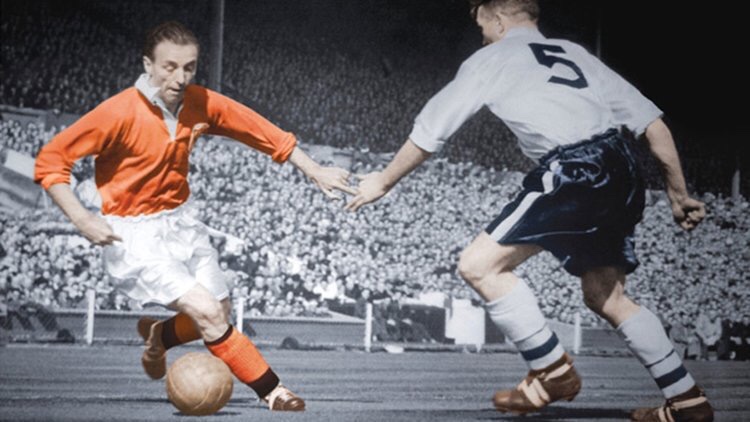
Sir Stanley Matthews
Born in 1915, Sir Stanley Matthews’ fabled talents are still revered about today, with the former England international winger generally being considered as one of the games all time greats.

In a career that spanned an incredible 33 years (though this included a six-year gap due to the Second World War), Matthews remains the only player to receive a knighthood while still playing, along with being the inaugural winner of both the European Footballer of the Year and Football Writers Association Player of the Year awards.
Growing up in Stoke-on-Trent, as a youngster Matthews was a supporter of Port Vale, though his first role in football was with local rivals Stoke City – playing for the reserve team as a 15-year-old.
The early promise shown by Matthews saw him offered a professional contract at Stoke a year later, taking home the maximum wage allowed of an early 1930’s footballer, £5 a week.
The winger would make his first team debut for Stoke away at Bury in 1932. From that point, the footballing career of Stanley Matthews would continue to flourish, playing more and more games for Stoke’s first team and developing in both physical and technical strength.
His consistent rise saw Matthews earn the first of his 54 England caps in 1934, and the 19-year-old had gained himself the reputation of a top class wide player – tricky, quick and with superb crossing ability.
Over the next few years, there would be rumours of discontent and jealousy towards Matthews from his club colleagues regarding his international success, leading to the winger putting in a transfer request, which was quickly refused by the Stoke City hierarchy.
As supporters rallied round their best player, Matthews commited himself to ‘The Potters’ and continued to perform admirably and consistently for them until the end of the 1938/39 season, when war commenced and no more Football League matches would be played for a seven-year stretch.
During wartime, a then 24-year-old Stanley Matthews would join the Royal Air Force, eventually taking on the senior role of corporal. Though no official Football League matches were played at this time, the winger would play numerous games for Stoke in the Wartime League as well as making guest appearances for the likes of Blackpool, Rangers, Airdieonians and Arsenal. Matthews would also make 29 (unofficial) appearances for his country in the wartime period as he combined his football and military duties, filling both roles with distinction.
As the Football League resumed in 1946, Matthews would return to his permanent footballing profession at Stoke – though a reported falling out with the management saw the winger make the move to Blackpool FC a year later.
Matthews thrived at Blackpool, given free reign to express himself and create opportunies. Winning the 1948 Football Writers Association Player of the Year award, Matthews led Blackpool to two F.A Cup finals in the following seasons, though finishing runners-up on both occasions.
However, Matthews would famously get his hands on the F.A Cup in 1953 – inspiring his Blackpool side (along with Stan Mortensen) to a thrilling comeback and a 4-3 victory over Bolton Wanderers in a showpiece later labelled as ‘the Matthews final’.

Heading towards his forties, Matthews began to be written off by certain areas of the press who thought time was catching up with the veteran. The player himself keenly disputed this and answered his critics in spectacular fashion – guiding Blackpool to some top end finishes and pipping the legendary Alfredo Di Stefano to the very first European Footballer of the Year prize in 1956.
In 1961, aged 46, Matthews returned to his first club, Stoke City, playing four more seasons before retiring when 50 years old. The quality and longevity of Matthews’ career saw him receive a knighthood (for services to football) shortly before the end of his playing career.
Sir Stanley Matthews passed away aged 85 in the year 2000, but had already been placed in the realms of footballing folklore for his ability, consistency, sportsmanship and dedication to the game. The character shown to serve his county’s military needs while also continuing to partake in his sporting profession is worthy of superlatives – though again, it was seen as something of a regular occurrence at that time.
This is just part of a plethora of reasons why Matthews deserves inclusion in the list of players who have shaped the game.
A 33-year career, played at a time when a very modest maximum wage was imposed on footballers, is incredulous in itself. Added to this, playing before, during and after the domestic and national complications and devastation caused by war together with the numerous individual awards and honours afforded to Matthews makes him, his life and his career a true definition of everything that encompassed football at this time.
Join us next time as we look at two more players who played a key role in shaping football and developing the game and it’s culture.
By Chris Kelly (@ccalciok)
 BehindClosedDoors